Impact of Socioeconomic Status on Addiction Rates: Statistics


Socioeconomic factors deeply influence who develops substance use disorders (SUDs) and how effectively they can be treated. In the United States, a broad range of data shows that individuals with lower incomes, limited education, or reduced access to health resources face disproportionately high addiction risks and worse outcomes.
Over the last 5 to 10 years, multiple reports indicate how poverty and social disadvantage correlate with higher rates of both illicit and prescription drug misuse.
This overview also highlights how better economic stability, supportive social networks, and improved treatment access can facilitate recovery success. Below, we’ll explore key data points and trends shaping the relationship between socioeconomic status and addiction.
Quick Snapshot: Noteworthy Statistics
- Nearly 90% of Americans with a diagnosable substance use disorder do not receive specialized treatment in any given year.
- Individuals living below the federal poverty line have about 36% higher odds of developing substance abuse issues than those in the highest income brackets.
- Drug overdose deaths among adults with no college education grew from about 12 per 100,000 in 2000 to 82 per 100,000 in 2021, far outpacing increases among more educated groups.
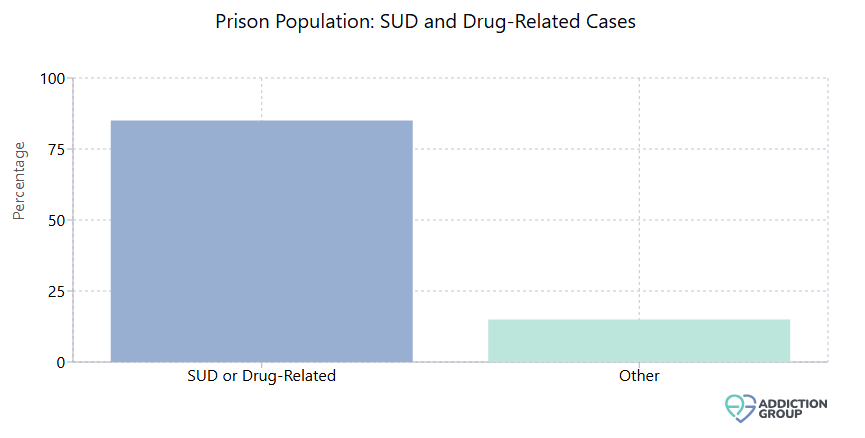
- 85% of the U.S. prison population either has an active substance use disorder or was incarcerated for crimes involving drugs or drug use.
Socioeconomic Factors Driving Addiction
It is important to understand how core socioeconomic indicators (income, education, and employment) shape addiction risk and prevalence.
Income-Level Disparities
- Lower-Income Prevalence: National data consistently show that people in households making under $20,000 per year have significantly higher rates of illicit drug use and alcohol misuse than those earning $75,000 or above.
- Poverty Overlaps: High-poverty neighborhoods often see compounded risk factors: poor access to healthcare, elevated stress levels, and limited supportive services.
- Cycle of Financial Strain: Addiction perpetuates financial instability, as funds meant for basic needs may go toward substances, leading to deeper poverty and, in some cases, homelessness.
Role of Education
- Protective Effect of Higher Education: Individuals who have completed college are much less likely to report past-year substance abuse or dependence. For many substances, addiction rates among college graduates can be half that of those without a high school diploma.
- Rising Overdose Deaths in Lower-Education Groups: Over the past decade, drug overdose rates have grown more steeply among those without high school or college credentials, reflecting a widening educational gap in addiction outcomes.
- Underlying Factors: Lower education often correlates with lower-paying jobs, less healthcare coverage, and poorer awareness of treatment options, reinforcing the cycle of addiction risk.
Employment Status
- Unemployment and Substance Abuse: Multiple studies show the unemployed have roughly twice the rate of SUDs compared to those in full-time work. Losing a job can trigger stress-related substance use, which can further harm employability.
- Unstable Work Patterns: People struggling with chronic addiction often cycle through jobs due to absenteeism, performance issues, or on-the-job accidents, inhibiting both career growth and financial security.
- Vicious Cycle: Unemployment undermines recovery resources (including insurance coverage), and active addiction makes finding or holding a steady job far more difficult.
Geographic Disparities and Housing Instability
Region and living conditions also shape addiction risk and severity. This section emphasizes how location and housing status influence both the likelihood of substance misuse and potential recovery.
Regional Differences
- Hardest-Hit Areas: Economically depressed regions, particularly parts of Appalachia and certain Rust Belt states, consistently experience some of the nation’s highest opioid overdose mortality rates.
- Rural vs. Urban Shifts: Once considered mainly an urban challenge, the opioid epidemic (including fentanyl) is now deeply impacting rural communities, where treatment facilities and mental health services are scarce.
- Income Inequality: Overdose deaths often spike in counties with pronounced income gaps, underscoring how social and economic inequality intersects with addiction trends.
Housing Insecurity
- Homelessness and Addiction: Surveys indicate around 38% of homeless individuals struggle with alcohol, and roughly 26% misuse other drugs, substantially higher than in the general population.
- Reciprocal Influence: Substance abuse can lead to eviction or inability to pay rent, while homelessness itself fosters severe stress and increased exposure to drug-using environments.
- Supportive Housing: Programs that place people in stable, affordable living situations before or during treatment have been shown to reduce relapse rates and promote longer-term sobriety.
Barriers to Treatment and Insurance Gaps
Understanding barriers to accessing effective treatment is crucial, as the vast majority of people with SUD remain untreated each year. Insurance coverage and affordability play a central role.
Limited Access to Care
- Low Treatment Utilization: Only about 10% of individuals who need substance use disorder treatment actually receive it in a given year, according to national surveys.
- Key Barriers: The most frequently cited reason for not seeking care, reported by roughly 37% of those aware of their SUD, is lack of insurance or inability to afford treatment. Transportation challenges and insufficient local facilities also impede access.
Insurance Coverage
- Impact on Treatment Rates: Having public or private health insurance dramatically increases the likelihood of receiving care, including evidence-based approaches such as medication-assisted treatment.
- Medicaid Expansion Effects: States that expanded Medicaid saw higher admissions for SUD treatment among low-income adults, but eligibility gaps remain in non-expansion states.
- Underinsurance and the Working Poor: Many individuals hovering above the poverty line do not qualify for Medicaid yet cannot afford robust private coverage, creating a coverage “gray zone.”
Cost of Treatment
- High Price Tag: Inpatient rehab can cost $14,000–$27,000 for 30 days if paid out-of-pocket, while outpatient programs may still cost several thousand dollars.
- Financial Strain: Individuals with addiction often face job loss or criminal justice expenses, compounding the struggle to fund rehab, therapy, or medications.
- Public Health Perspective: Though treatment can seem expensive upfront, research indicates that it saves far more in reducing crime, healthcare, and unemployment costs over the long run.
Social and Intergenerational Dynamics
Addiction does not occur in a vacuum; family environment and social networks can both mitigate and magnify the risk.
Social Support Networks
- Protective Factor: People with strong familial or peer support are more likely to remain in treatment and less likely to relapse.
- Negative Influence: Conversely, having friends or relatives who themselves misuse substances can make it far harder to achieve sobriety.
- Stress of Economic Hardship: Low-income households often experience overlapping challenges, such as limited resources and possible co-occurring mental health issues, that reduce the capacity for effective social support.
Intergenerational Patterns
- Poverty and Substance Use in Childhood: Growing up in financially insecure environments increases the likelihood of developing an SUD later.
- Parental Addiction: Children of parents with substance abuse issues are several times more likely to misuse alcohol or other drugs as adults, often due to a mix of genetic predisposition and environmental exposure.
- Breaking the Cycle: Early intervention, stable home environments, and comprehensive family-focused programs help reduce the perpetuation of addiction from one generation to the next.
Economic Burdens: Productivity, Crime, and Mobility
Addiction imposes heavy financial and social costs on individuals, families, and society. Work productivity, criminal justice involvement, and long-term economic mobility are all deeply affected.
Workplace Productivity
- Employer Costs: Substance misuse among employees costs American businesses over $80 billion annually in lost productivity, absenteeism, and turnover.
- Labor Force Impact: High addiction rates contribute to declining labor force participation, particularly in communities hit hard by the opioid epidemic.
- Potential for Improvement: Workplace-based interventions (Employee Assistance Programs, supportive policies) can increase retention, reduce costs, and support recovery.
Addiction and Crime
- Substance-Involved Incarcerations: Approximately 85% of individuals in prison either committed drug-related offenses or have an active SUD.
- Criminal Behavior Drivers: Economic-compulsive crimes (theft, robbery) to fund drug purchases and systemic violence tied to drug trafficking elevate crime rates in disadvantaged neighborhoods.
- Shift Toward Treatment: Many jurisdictions are moving from punitive approaches to drug courts and diversion programs, recognizing that evidence-based treatment reduces recidivism more effectively than incarceration alone.
Long-Term Economic Mobility
- Downward Spiral: Individuals who develop addiction in their formative years often drop out of school or face career derailment, suppressing their earning potential.
- Entrenched Poverty: When addiction coexists with low SES, it can lock entire families into a cycle of economic instability, hindering upward mobility across generations.
- Opportunities for Recovery: Programs that combine SUD treatment with job training and stable housing show promise, but the journey to financial stability after addiction is often long and fraught with obstacles.
Final Thoughts on the Broader Implications
Addressing the socioeconomic drivers of addiction is imperative for lowering drug misuse rates and improving public health outcomes.
When individuals secure steady employment, stable housing, comprehensive healthcare, and a strong support network, they are far better positioned to avoid or overcome substance dependence.
Social policies that promote affordable treatment and education can help break the cycle of poverty and addiction, sparing future generations from the same pitfalls.
Equally important is the recognition that long-term recovery involves more than initial sobriety. By tackling these interconnected issues, society stands to gain both economically and in overall well-being.
- Centers for Disease Control and Prevention (CDC) – https://www.cdc.gov/data-statistics
- Harvard Health – https://www.health.harvard.edu
- National Institute on Drug Abuse (NIDA) – https://nida.nih.gov
- National Survey on Drug Use and Health (NSDUH), SAMHSA – https://www.samhsa.gov/data/report/2022-nsduh-annual-national-report
- PubMed Database – https://pubmed.ncbi.nlm.nih.gov/17156173/
- U.S. Department of Health & Human Services (HHS) – https://www.hhs.gov/opioids/

