National Drug Court Statistics: Trends, Outcomes, & Challenges


Drug courts have become a cornerstone of the justice system’s response to substance abuse, offering an alternative to incarceration for individuals whose criminal behavior stems from addiction.
Numerous studies have documented their impact on recidivism, cost savings, and broader social outcomes over the past several decades.
In this article, we’ll review the latest data on U.S. drug courts, covering success rates, cost-benefit findings, recidivism trends, demographic patterns, and more, to provide a comprehensive understanding of how these specialized courts operate and why they continue to grow nationwide.
Quick Snapshot: Key Drug Court Statistics
- Graduation Rates: Adult drug court graduation rates typically range from 50% to 70%, with some specialized courts (e.g., DUI courts) exceeding 75% completion.
- Cost Savings: Every $1 invested in drug courts yields between $2 to $4 in direct taxpayer savings, with broader social benefits sometimes reaching $27 per dollar spent.
- Recidivism Reduction: Drug court participants are 6 to 26 percentage points less likely to be re-arrested than those in traditional court settings, with graduates showing even lower re-offense rates over time.
- Nationwide Scope: As of recent counts, there are over 3,800 treatment courts across the U.S., comprising adult drug courts, family treatment courts, juvenile drug courts, veterans courts, and more.

Why These Data Matter
Drug courts represent a key strategy in reducing substance use and crime simultaneously. The numbers below illuminate how drug courts improve public safety, save government resources, and provide meaningful rehabilitation options for participants who otherwise might cycle through repeated arrests and incarceration.
Graduation and Program Completion Rates
- Overall Adult Completion: Adult drug courts often see completion rates of 50 to 70%, surpassing traditional probation retention.
- Specialized Court Variations:
- DUI Courts: Often achieve around 75 to 80% graduation.
- Family Treatment Courts: Closer to 47% on average, likely reflecting the complex child welfare issues they address.
- Veterans Courts: Around 75% completion, bolstered by tailored services for PTSD and other combat-related issues.
| Treatment Court Type | Typical Graduation Rate (%) |
| Adult Drug Court (ADC) | 50 to 60 |
| DUI/DWI Court | 75 to 80 |
| Family Treatment Court | ~47 |
| Veterans Treatment Court | 75 to 80 |
| Juvenile Drug Court | ~60 |
- Predictors of Success: Employment, stable housing, and consistent case management correlate with higher completion. Courts that permit medication-assisted treatment (MAT) for opioid-use disorders see improved retention among opioid-dependent participants.
Cost-Benefit Analysis
- Taxpayer Savings: Studies frequently show a 200 to 400% return on investment (ROI) in terms of reduced incarceration, fewer arrests, and lower court expenses.
- Broader Economic Benefits: When factoring in intangible costs, like victimization, foster care, and healthcare, some analyses estimate up to $4 to $27 in benefits per dollar spent.
- Program Variations: While most programs yield net savings, the extent can fluctuate based on local implementation. Programs targeting higher-risk populations typically realize the greatest return.
Recidivism Trends and Long-Term Outcomes
One of the most frequently cited advantages of drug courts is a measurable reduction in recidivism compared to traditional adjudication.
Why This Data Is Important
High recidivism not only burdens public finances but also creates ongoing societal harm. Identifying whether drug courts meaningfully reduce re-offense and how long the effect lasts is critical for evaluating long-term safety and cost-effectiveness.
- Reduced Re-Arrest Rates: Drug court participants are often 6 to 26 percentage points less likely to be rearrested, with some courts reporting recidivism reductions of up to 50% among graduates.
- Long-Term Impact: Follow-up studies at 3, 5, and 10+ years post-graduation reveal persistently lower re-offense rates among former participants. Some evaluations document effects lasting as long as 15 years.
Graduation vs. Non-Completion
- Graduates generally report lower rearrest rates compared to those who fail to complete the program.
- Even participants who do not graduate tend to spend longer in treatment than they would have voluntarily, which can still reduce substance use during that window.
Program Duration and Treatment Retention
Most adult drug courts run for at least 12 months, with many lasting 18 to 24 months. Research indicates that more extended supervision helps participants solidify sobriety skills and reduce relapse.
Why This Data Is Important
Adequate time in treatment correlates with sustained behavior change. Shorter programs (under nine months) may lack the intensity needed for entrenched addictions.
- Optimal Length: Multiple studies emphasize 9 to 12 months of continuous treatment as a threshold for meaningful results.
- Phase Structures: Participants typically move through phases, with strict monitoring in the initial stages and gradual independence as they progress.
Substance Type Considerations
Substance use disorders vary widely, from alcohol dependence to opioids to methamphetamine. Drug courts adapt to these differences by offering specialized interventions.
Why This Data Is Important
Treatment needs for opioid dependence often differ from those for methamphetamine or alcohol. Tailoring interventions boosts success.
- Opioid Users: Programs that incorporate MAT (e.g., methadone or buprenorphine) see higher retention and lower relapse for opioid-dependent participants.
- Alcohol-Focused (DUI) Courts: Tend to achieve some of the highest graduation rates—often 75% or more.
- Stimulants (Meth/Cocaine): With no medication equivalent, drug courts often use contingency management and cognitive behavioral therapy. While graduation rates can be lower, successful participants show substantial reductions in substance use.
Demographics and Disparities
Drug courts strive to serve offenders from varied backgrounds equitably, but differences in access and outcomes do arise.
Why This Data Is Important
Understanding who participates and succeeds reveals where policy reforms or resource enhancements might be needed.
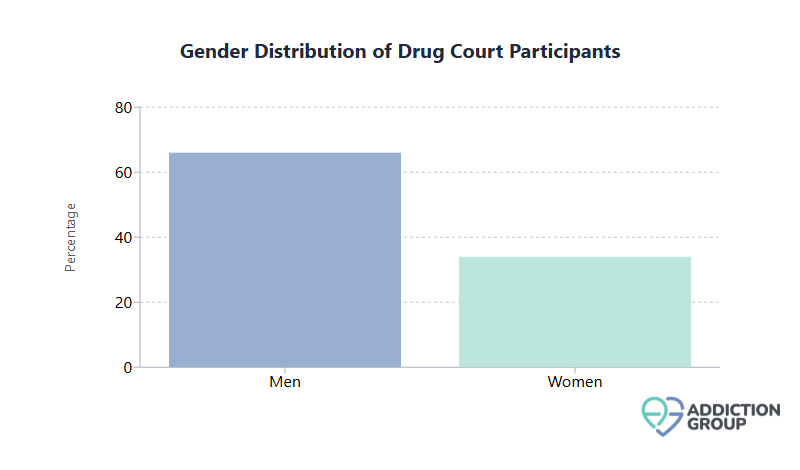
- Gender: Men comprise about two-thirds of participants. Graduation rates for men vs. women are typically within a few percentage points of each other, but gender-responsive services (e.g., trauma-informed care) can boost women’s success.
- Age: Younger participants generally have more trouble completing the program, while older individuals are more likely to succeed and less likely to re-offend post-graduation.
- Race/Ethnicity: White participants often graduate at slightly higher rates than Black participants, reflecting a 4 to 5 percentage point gap nationally. Courts are increasingly focused on cultural competence and equitable admission processes to close this disparity.
- Socioeconomic Factors: Participants with stable housing and employment at intake fare better, though drug courts often help the unemployed and homeless gain stability by graduation.
Geographic Variation and Accessibility
Drug courts exist in all U.S. states, but their availability and capacity differ.
Why This Data Is Important
Individuals in underserved regions may miss out on the chance for a treatment-based alternative to incarceration.
- Urban vs. Rural:
- Urban courts benefit from more robust treatment providers but can suffer from high caseloads.
- Rural courts face hurdles like limited public transportation and fewer treatment centers, yet smaller participant loads can allow more personalized attention.
- National Spread: Over 3,800 treatment courts operate in the U.S., including more than 1,600 adult drug courts, with ongoing efforts to expand coverage in remote areas.
Support Services and Wraparound Care
Quality drug courts extend beyond regular court check-ins, ensuring participants receive comprehensive help.
Why This Data Is Important
Because addiction often coexists with mental health issues, unemployment, and homelessness, robust support networks can be the deciding factor between success and relapse.
- Mental Health Care: Many participants have co-occurring disorders; programs that integrate counseling and psychiatric treatment show better graduation rates.
- Housing Assistance: Transitional or “sober living” housing is frequently provided, raising overall program retention and reducing relapse risks.
- Employment & Education: Courts partner with job agencies to deliver training and classes. Some reports show that 87% of drug court graduates are employed by completion.
- Family and Parenting Services: Particularly critical in family treatment courts, these services have more than doubled reunification rates in some studies, leading to faster permanency decisions and reduced foster care costs.
Family Reunification Outcomes
Family drug courts address child welfare cases where parental substance abuse is central. Their data on reunification rates is striking.
Why This Data Is Important
The intergenerational cycle of addiction can be broken when parents recover and children remain safely in or return to a stable home.
- Reunification Rates: Studies show twice the likelihood of regaining custody for family drug court participants compared to traditional dependency court processes.
- Reduced Foster Care Stays: Children generally spend fewer months in out-of-home care, lessening both emotional and financial burdens on families and child welfare agencies.
Employment and Housing Outcomes
For many participants, stable employment and housing are benchmarks of recovery. Drug court programs intentionally monitor and support these areas.
Why This Data Is Important
Securing a job and safe housing aligns with lower criminal activity and relapse, critical markers of successful reintegration.
- Employment Gains: Many participants enter with no income or unstable work histories. By graduation, upwards of 80% or more hold steady employment, a core contributor to self-sufficiency.
- Housing Stability: Courts often help participants obtain transitional or independent housing. In one multiyear evaluation, 100% of graduates had stable housing at discharge.
Long-Term Impact and Quality of Life
Drug courts offer more than crime reduction; they transform health, relationships, and personal well-being.
Why This Data Is Important
Success is not just about avoiding re-arrest but also about living productively and restoring family and community ties.
- Physical & Mental Health: Access to addiction treatment, mental health care, and consistent monitoring yields significant improvements in overall wellness.
- Self-Esteem & Social Support: Many graduates report heightened confidence, improved family relations, and stronger support networks.
- Reduced Public Health Risks: For opioid-dependent participants, MAT can dramatically lower overdose risks and infectious disease transmission, benefiting the broader community.
Program Eligibility and Barriers to Entry
Not everyone who could benefit from drug court receives it. Eligibility criteria and program capacity can exclude certain individuals.
Why This Data Is Important
Greater inclusivity could expand the court’s benefits, but policies must also protect public safety and manage finite resources.
- Typical Exclusions: Individuals with recent violent felonies, large-scale drug trafficking charges, or severe untreated mental health conditions may be excluded.
- Acceptance Rates: Some potential participants decline the program due to its rigor, preferring a shorter jail term rather than the lengthy supervision demanded by drug court.
- Racial and SES Barriers: Data suggest that people of color are underrepresented in some jurisdictions, spurring reforms like bias training and standardized assessment tools.
Final Summary
Drug courts have demonstrated consistent success in lowering recidivism, reducing criminal justice costs, and improving public health outcomes. Their intensive structure allows participants to address the root causes of their substance abuse.
This model surpasses traditional court processes by facilitating meaningful rehabilitation and encouraging a shift from offender to accountable, thriving community member.
Equally significant are the broader social benefits: stable housing, workforce engagement, and healthier family dynamics. With specialized adaptations for veterans, parents with open child welfare cases, and individuals with co-occurring mental health challenges, drug courts continue to evolve to meet the needs of diverse populations.
The evidence consistently points to expanded coverage and inclusive admission policies as the next frontier. These policies ensure that anyone who could benefit from a treatment-driven approach receives that opportunity.
Ultimately, the data tell a compelling story of transformation. Drug courts do not merely reduce crime; they shift lives onto more positive trajectories. These courts strengthen families, support recovery, and promote a more cost-efficient, rehabilitative approach to justice.
- Bureau of Justice Assistance (BJA) – https://bja.ojp.gov/news/blog/30-years-drug-courts-justice-reform-works
- GAO . Adult Drug Courts: Studies Show Courts Reduce Recidivism (GAO-12-53) – https://www.gao.gov/assets/gao-12-53.pdf
- GAO . Adult Drug Court Programs: Factors Related to Eligibility and Acceptance (GAO-23-105272) – https://www.gao.gov/assets/gao-23-105272.pdf
- Kansas University (KU News). Family Drug Court Study – https://news.ku.edu/news/article/2015/11/12/families-more-twice-likely-be-reunited-when-taking-part-family-drug-court-backed-ku
- National Drug Court Resource Center (NDCRC). Painting the Current Picture 2022 – https://ntcrc.org/wp-content/uploads/2022/08/PCP_2022_HighlightsInsights_DigitalRelease.pdf
- National Institute on Drug Abuse (NIDA). Medications to Treat Opioid Addiction – https://nida.nih.gov/publications/research-reports/medications-to-treat-opioid-addiction/efficacy-medications-opioid-use-disorder
- REA Analytics. Grand Rapids Drug Court Performance Assessment 2024 - https://reaanalytics.com/df_media/W1siZiIsIjIwMjQvMDkvMjUvMTEvMDcvNDAvOWVmMTY1MjMtOWRmNi00OWI2LWFmZjktM2Q3MWI0MjAwMzBiL0dSREMgRmluYWwgUGVyZm9ybWFuY2UgQXNzZXNzbWVudCAyMDI0LnBkZiJdXQ/GRDC%20Final%20Performance%20Assessment%202024.pdf?sha=60d9d9f11ade0fd1
- Wisconsin Association of Treatment Court Professionals (WATCP). Drug Courts: The Good, the Bad, and the Misunderstood – https://www.watcp.org/wp-content/uploads/2022/04/Drug-Courts_The-Good-The-Bad-The-Misunderstood_Doug-Marlowe.pdf

